
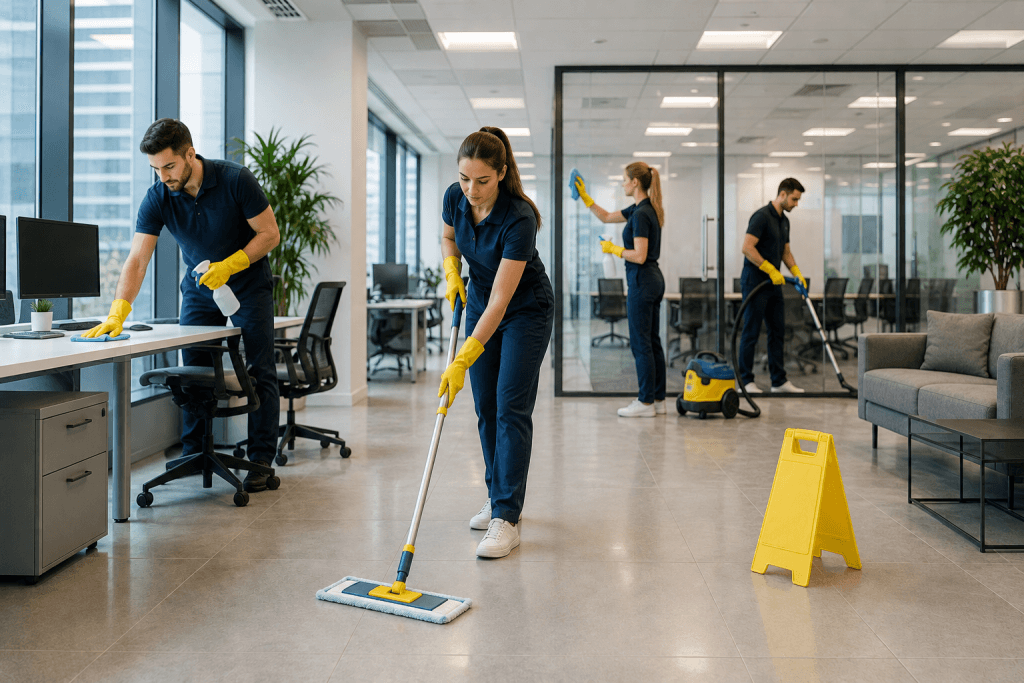
The retail and tourism figures seem to be moving along well; there is more and more activity through the doors of businesses in Malaysia. As customer traffic increases, many businesses are also reviewing their cleaning services for commercial properties to ensure hygiene standards keep pace with daily operations.
The number of foreigners who visited Malaysia in 2025 reached 42.2 million people, a figure representing an increase by 11.2% compared to 2024. Visit Malaysia 2026 intends to attract 43 million visitors. However, according to the Department of Statistics Malaysia (DOSS), the amount of wholesale and retail trade in April 2026 equaled RM 174.8 billion, rising by 15.3% annually.
Good news for retailers, restaurants, and those managing office and commercial properties: more activity is coming. It also highlights the limitations of cleaning policies based solely on a facility’s square footage and fixed schedules.
Divide the premises by use
At Jashan, we find it more useful to separate a commercial property into operational zones.
Continuous-attention zones may include entrances, reception areas, washrooms, lifts, and customer counters. These need inspections or light maintenance during operating hours.
Scheduled-use zones include meeting rooms, fitting rooms, training spaces, and shared pantries. Their cleaning frequency should follow bookings, meal periods, or customer peaks.
Lower-traffic zones may include storage rooms, private offices, and archives. These still require regular care, but servicing them too frequently can consume time that would be better spent elsewhere.
The categories will differ between businesses. A medical clinic, retail outlet, warehouse, and corporate office cannot share the same checklist simply because their total areas are similar. This is why cleaning services for commercial facilities should always be planned according to the way each space is used rather than its size alone.
The busiest hour should influence the schedule
Preparing a facility for opening with an end-of-day cleaning is one option. However, it is impossible to provide cleaning services throughout the day while customers are present.
After busy shopping periods, retail stores may need additional cleaning to keep entrances and fitting rooms spotless. The pantry and washrooms of office premises may require cleaning both in the morning and afternoon. Event venues may not require full cleaning between sessions, but they still need to be kept clean throughout the day.
For LK’s prime retail market, leasing demand was very high, while the occupancy rate was “modest” in Q1 2026. In the existing malls, the activities were sustained by international brands, food & beverage stores, and experiential retail concepts.
Cleanliness is an ongoing process for such businesses. A customer will never know that the washroom was cleaned at 8 a.m. if the washroom is not clean at 2 p.m.
A proper cleaning service for commercial buildings needs both scheduled cleaning and quick inspections. Such inspections can be used to take care of stains, full garbage bins, low supplies, or marks. The same principle applies to cleaning services for commercial environments where maintaining cleanliness throughout operating hours is just as important as completing scheduled cleaning tasks.
Records improve the plan
There is no need for complicated monitoring software to manage commercial cleaning. It takes only a very basic record to identify problem areas.
Businesses can note:
- The times bins fill most quickly
- Which washrooms need more frequent restocking
- Where rainwater and outdoor dirt enter the building
- Which rooms require attention after scheduled use
This becomes more clearly visible after a few weeks. Cleaning time can then be focused on the areas where it will have the greatest impact. Records help distinguish between cleaning issues and maintenance issues. If floors remain wet regularly for a long period, it may be caused by a leak. If an odor persists, the cause may be a drainage issue. If marks regularly appear near entrances, the issue may be the floor matting rather than the mopping.
A commercial plan should reflect the business
Jashan Corporation offers office cleaning, industrial, and janitorial services, as well as post-construction cleaning, on daily, weekly, and monthly schedules to suit operational needs. Dusting, vacuuming, disposal of trash, floor cleaning, and maintenance of common areas are some examples of services we offer.
In order to determine the cleaning requirements of commercial properties, simply counting the number of rooms will not be sufficient. The cleaning plan will depend on the operation hours, number of employees, customer traffic, type of surfaces, restricted areas, and many other factors.
It is important to remember that the most useful schedule for cleaning will not necessarily apply to all the rooms. This will help to concentrate on those places which are visited frequently, places where standards decline the fastest, and where something missed would probably be found. Businesses that invest in cleaning services for commercial properties can better align their cleaning schedules with real operational demands instead of relying on fixed floor plans.
While cleaning may be measured by square footage, the actual cleaning requirements are determined by how people move through the space.